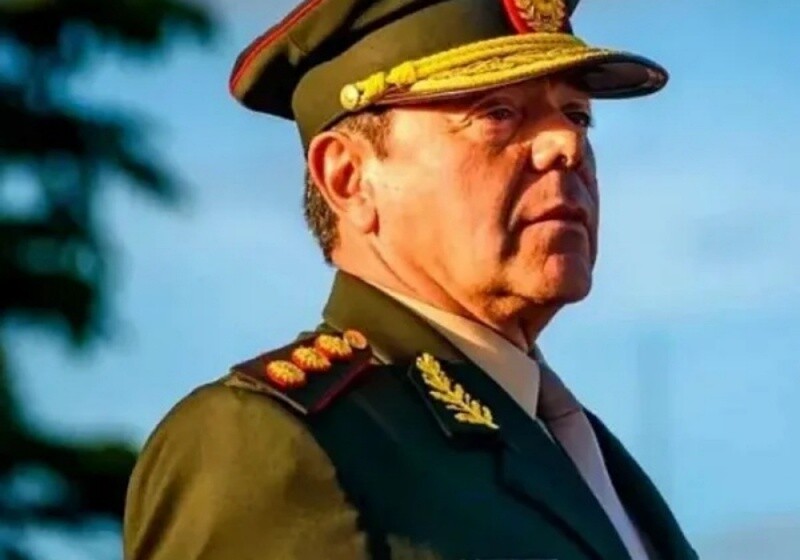
We share the different reactions to the decision of the national government to appoint the head of the Army General Staff, Carlos Alberto Presti, as head of the Defense Ministry. Presti is the son of Carlos Roque Presti, who died unpunished but was accused of commanding the 7th Infantry Regiment in La Plata, which included the clandestine detention, torture, and extermination centers La Cacha, Arana, and Police Station 5th.
Some point out the connections that Carlos Presti himself has with the United States (...). Trump proposed to them as a priority the fight against the "internal enemy" and the use of American cities as training grounds for imperialist wars (...).
More and more family members of genocidals are joining the Milei and Villarruel government. This trend signifies an advance towards the militarization of internal politics with the consequent risk of politicizing the armed forces, which are now entering directly into the government's internal conflicts.
It does not seem like a coincidence that the construction of the "internal enemy" as a doctrine once again comes from the north. Therefore, we appeal to the historical memory that constitutes us as a people and to the awareness of all of society to firmly reject this attempt to "whitewash" history and militarize politics.
From the Center for Legal and Social Studies (CELS), they considered that the choice of Presti "breaks the principle of civilian control and aligns the country with a belligerent geopolitical agenda driven by the United States. This imprint, which has spread in the SIDE, in the Ministry of Security, and in Defense, gives a belligerent and military character to government areas that demand a political and civil logic.
Capital warned: "His father, Roque Carlos Presti, was accused of crimes against humanity committed by state terrorism (...). The increasingly anti-democratic and isolated positions and votes in multilateral forums (such as the lack of condemnation of torture) are reproduced in the military sphere: the search to be a global partner of NATO and to reinforce the relationship with the United States Southern Command are just two examples."
"A few months before the 50th anniversary of the 1976 military coup, the government announced the appointment stating that the 'demonization' of the armed forces must end. Anything that comes from Defense from now on regarding trials for crimes against humanity is not going to contribute. Meanwhile, we continue to ask: where is Clara Anahí?"
The president of Grandmothers of Plaza de Mayo, Estela de Carlotto, stated that the appointment constitutes a "provocation" by the Government: "This is initiating a situation of violence in society, when we already know the life that Argentina has had with coups, dictatorships, and everything we have suffered." She added that the Government "is tormenting the country with strange ideas and we have the obligation to stop it": "The one who has a military vocation should be in that vocation and fulfill the obligation to defend and defend us, but state policies are managed by civilians. Does he know who appropriated Clara Anahí Mariani?"
Another prominent complainant in cases of crimes of state terrorism, Pablo Llonto, at the head of the Mario Bosch Lawyers' Collective, described the situation as "a huge concern" and warned that Presti's arrival could affect the policies of Memory, Truth, and Justice: "It casts shadows on the continuity of democracy, because symbolically it is a step backward (...). 50 years after the coup, the government uses revisionist rhetoric to justify a turn that reinstates the military at the center of political power."
They point out that this appointment "must be read for its consequences inside and outside the country, internal and external policy, two levels that are directly intertwined: on the one hand, the militarization of politics, and on the other, the politicization of the armed forces that reinforces the consensual dependence on the United States."
"Internally, it takes to a new level the trend of this government to appoint active or retired military personnel in key positions. Even in highly militarized countries, such as the United States, precisely to safeguard civilian control, a former military officer cannot be appointed as Secretary of Defense unless they have been out of service for the last 7 years, which is extended to 10 in the case of generals and admirants," they warn.
"It is a decision of great symbolic and operational weight in relation to the alignment with a bellicose geopolitical agenda that moves away from international law. More than a year has passed since Milei announced at the United Nations that Argentina was abandoning its historical position of neutrality, which led to a subordination to the United States, even in the event of situations of high conflict and that are deployed in our region. It is necessary to insist that the Armed Forces were not demonized, but that almost 50 years ago they orchestrated a criminal plan against Argentine society after having seized power illegally. Then, Milei takes advantage of Petri leaving the Ministry to turn in the same direction. These are inventions that destroy our identity."
During the genocidal dictatorship, Roque Carlos Presti was in command of the Infantry Regiment 7 in La Plata, in charge of repression in Area 113. Before, judicial requests were answered, but this generates uncertainty."
The Ecumenical Movement for Human Rights (MEDH) also manifested its "most energetic repudiation": "It constitutes a serious setback in one of the fundamental pillars of our democracy, which sought to end the military influence on political life after the last and bloodiest civic-military-business dictatorship (...). The current Chief of the Army General Staff, Lieutenant General Carlos Alberto Presti, who will now leave his post to assume as the new Minister of Defense, did he ask his father about her, as any person not committed to impunity would have done?"
The notion of government and civilian control points to the fact that the person in charge of governing the forces should be a delegate of the political authority and not the representative of the military corporation in the cabinet. He is also responsible for other operations, such as the one carried out to kidnap high school students in what is known as the 'Night of the Pencils.' He was one of those responsible for the operation where Diana Teruggi and other militants were murdered in November 1976 in the house located on 30th Street, between 55 and 56. Under that sphere, the clandestine centers La Cacha, Arana Well, and Police Station 5th, among others, functioned (...). It implies a contempt for the notion of civilian control of the armed forces, a principle of many democracies aimed at ensuring that institutions that have weapons cannot be autonomous from sovereign authority. Silence is a pact with impunity."
Myriam Bregman, elected deputy for the Front of the Left and a lawyer and member of CEPRODH (Center of Professionals for Human Rights), expressed: "The appointment seems to be another expression of the vassal subordination to the United States. Among the cases is the attack on the Teruggi-Mariani house, after which Clara Anahí Mariani-Teruggi, who was 3 months old when the repressive operation in which Presti is accused of having been part was carried out, remains disappeared (...). They are changing what is already history to make a new history that serves no purpose or is dangerous."
From H.I.J.O.S. The seriousness of this appointment is emphasized with this revisionist rhetoric, which marks the re-entry of a military man as minister," they conclude from CELS.